
Glory Seoul Eye Clinic · Gangnam, SeoulClearer vision in Gangnam, built on trust.

Seoul National University-trained ophthalmologists offering all-laser LASIK, LASEK, Clear Smile LASIK, implantable lenses (ICL), presbyopia correction and laser cataract surgery — right by Gangnam Station.

Eye procedures performed (clinic records)
50,000+
Experience in vision correction
15+ yrs
Comprehensive eye exam
30–40 min
Right by Gangnam Station
Exit 8
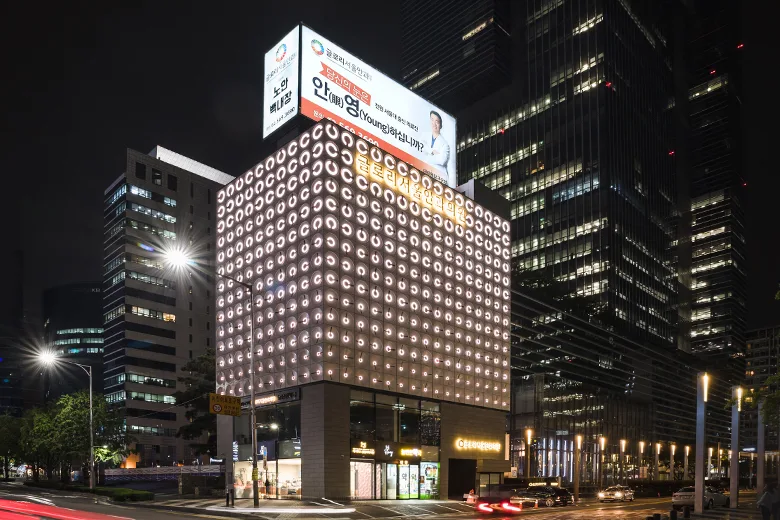
Glory Seoul Eye Clinic building lit up at night near Gangnam Station in Seoul

Gangnam Station Exit 8 · English service

Greetings

Skill builds trust.

Our eye specialists and staff welcome you to Glory Seoul Eye Clinic. We are located in Gangnam, the heart of Seoul, where innovative and proven medical techniques are practiced every day.

In eye surgery, what matters most is refined skill, experience, technology and in-depth knowledge of related fields. Ophthalmic technology keeps advancing in precision, and every patient deserves its benefits — whether to improve vision or to treat eye diseases such as cataracts.

We use up-to-date devices to diagnose and correct vision, and our dedicated optometrist focuses on high-quality eye check-ups. Everything we do is based on trust, confidence and integrity.

Dr. O-Sub Koo (Robert)

Representative Director, M.D., Ph.D., Ophthalmologist

More about our doctors →

The meaning of our name

Our name reflects what we hope to give every patient: a star that stands for light, hope and excellence, and bright eyes that stand for clear, beautiful and healthy vision.

Vision
To be a leading brand in Korean ophthalmology, with the highest satisfaction among both staff and patients.
Mission
To give every patient a moving, happy medical experience through excellent specialist care and quality service.
Values
Professional care (medical excellence, quality service, ongoing clinical research), respect and communication (teamwork, positive thinking and action), and social responsibility (integrity and service).

Four things that define us

  • 01

    Seoul National University medical team

    Our ophthalmologists graduated from Seoul National University College of Medicine.

  • 02

    Extensive clinical experience

    Cornea, retina and cataract surgeons with more than 15 years of vision-correction experience.

  • 03

    Lifelong care

    A patient-centred pre- and post-operative care system, with a lifelong follow-up program for our patients.

  • 04

    Specialized equipment

    Dedicated laser systems for each procedure, from all-laser LASIK to femtosecond laser cataract surgery.

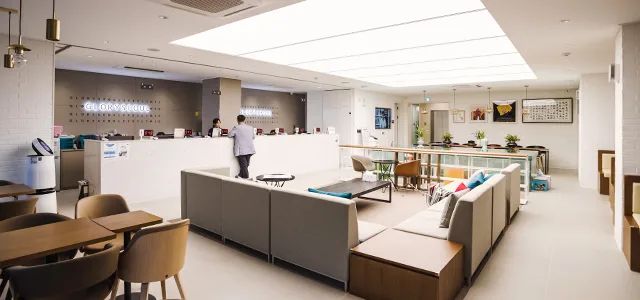
Bright waiting lounge with sofas and large windows at Glory Seoul Eye Clinic
Staff member guiding a patient through the clinic
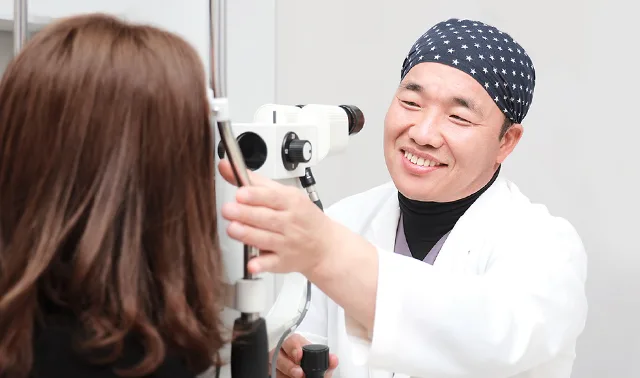
Ophthalmologist examining a patient with a slit-lamp microscope

Recognized by

Our Ophthalmologists

Experienced cornea, retina and cataract surgeons

Our surgeons have performed more than 50,000 procedures over 15+ years (clinic records), supported by advanced laser systems and a patient-centred pre- and post-operative care system.

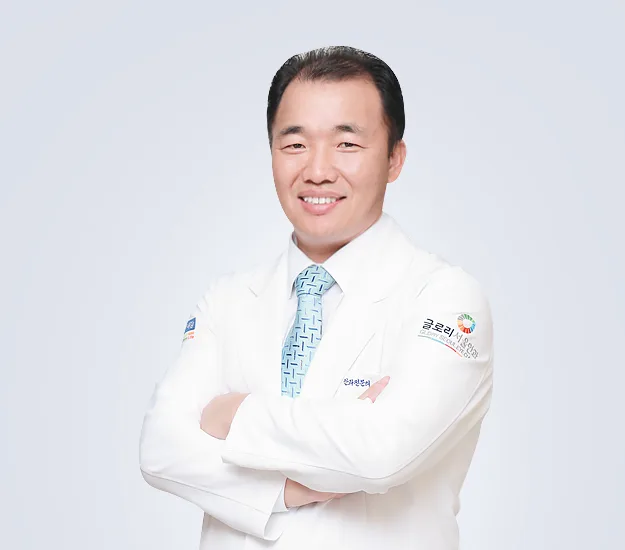
Dr. O-Sub Koo, representative director of Glory Seoul Eye Clinic, in a white coat with arms crossed

Representative Director · Ophthalmologist, M.D., Ph.D.

Dr. O-Sub Koo (Robert)

  • LASIK & LASEK
  • Phakic IOL (ICL)
  • Cataract surgery
  • Presbyopia

Education & memberships

  • · Graduate, Seoul National University College of Medicine
  • · Master’s degree and Ph.D. in Ophthalmology
  • · Member, Korean Ophthalmological Society
  • · Member, Korean Contact Lens Study Society
  • · Member, Korean Society of Cataract and Refractive Surgery
  • · Certified surgeon, VISIAN ICL
  • · Certified surgeon, ARTISAN Phakic IOL
  • · Representative Director, Seoul Eye Group Network
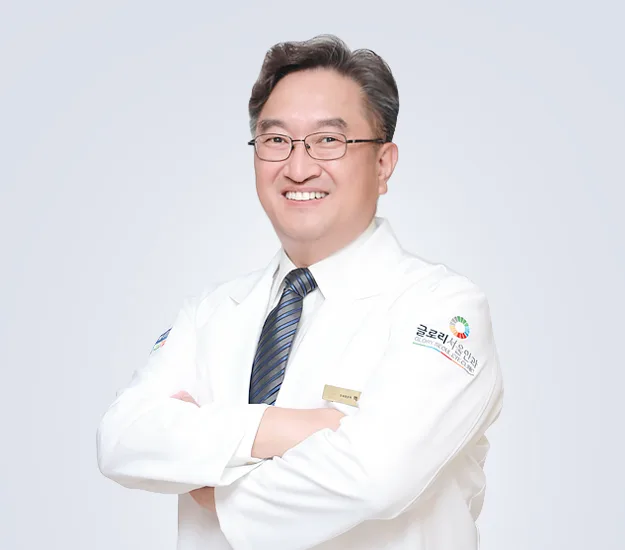
Dr. Jin-gu Park, ophthalmologist at Glory Seoul Eye Clinic, wearing glasses and a white coat

Representative Director · Ophthalmologist, M.D.

Dr. Jin-gu Park (Jacob)

  • Refractive surgery
  • Phakic IOL (ICL)
  • Cataract surgery

Education & memberships

  • · Graduate, Seoul National University College of Medicine
  • · Former director, Myeongdong Eye Clinic
  • · First Representative Director, Seoul Eye Group Network
  • · Member, Korean Ophthalmological Society
  • · Member, Korean Contact Lens Study Society
  • · Member, Korean Society of Cataract and Refractive Surgery
  • · Certified surgeon, VISIAN ICL
  • · Certified surgeon, ARTISAN Phakic IOL

Why patients choose Glory Seoul

  • Experienced surgeons

    • Specialists in the cornea, retina and vitreous
    • Trained at a top Korean medical school
    • Doctors who listen before they talk
  • Advanced equipment

    • A dedicated laser platform for each procedure
    • Regular equipment maintenance
    • Malpractice insurance in place
  • Pre- & post-operative care

    • Thorough, detailed eye examinations
    • Concierge support and English service
    • Lifelong follow-up program (terms explained at consultation)
  • Fair pricing

    • Competitive prices for comparable equipment and materials
    • Clear quotes after your examination
    • VAT rules explained before treatment

Our laser platforms

A dedicated system for each procedure, regularly maintained.

iFS Plus
Femtosecond laser for blade-free LASIK flaps
AMARIS 750S
Excimer laser for LASEK and LASIK
MEL 80
Excimer laser for Laser Blended Vision (LBV)
VISX STAR IR
Excimer laser for refractive correction
FEMTO LDV Z8
Low-energy femtosecond laser for Clear Smile LASIK
CATALYS
Femtosecond laser system for cataract surgery

Common Conditions

Understanding your vision

Advances in vision-correction surgery can reduce or even eliminate dependence on glasses and contact lenses. Before choosing a procedure, it helps to understand your condition, the pros and cons of each option, and what to expect before, during and after treatment.

  • Nearsightedness (myopia)

    Light from distant objects focuses in front of the retina because the eye is too long or the cornea or lens is too strong. Near objects look clear, distant ones blurred.

  • Farsightedness (hyperopia)

    Light from nearby objects focuses behind the retina because the eye is too short or the cornea or lens does not bend light enough. Close-up objects can look blurry.

  • Astigmatism

    An imperfection in the curvature of the cornea or lens — shaped more like a rugby ball than a football — creates more than one point of focus and causes blurred or distorted vision.

  • Presbyopia

    A natural, age-related loss of the lens’s flexibility that makes it hard to focus on close objects. It usually becomes noticeable in the early to mid-forties.

  • Cataracts

    A clouding of the eye’s normally clear lens. It acts like frosted glass, scattering light and gradually making vision blurry and dull.

  • Find out where you stand

    A comprehensive eye exam takes about 30–40 minutes, and you don't need to have a procedure afterwards.

    Make an Appointment

Major procedures by age

Procedures offered at Glory Seoul Eye Clinic and the typical recommended age
TypeProceduresTypical age
Refractive laser eye surgery
  • LASIK
  • LASEK
  • Clear Smile LASIK
  • Phakic IOL (implantable lens)
Early 20s – late 30s
Presbyopia
  • LBV (Laser Blended Vision) LASIK
  • Multifocal lens surgery with the Catalys laser
From the early 40s
Cataracts
  • Multifocal laser cataract surgery (Catalys)
Late 40s, 50s, 60s and 70s

Refractive Surgery

LASIK, LASEK & Clear Smile LASIK

Refractive surgery corrects common vision problems — nearsightedness, farsightedness, astigmatism and, in some cases, presbyopia — to reduce your dependence on glasses and contact lenses. The main difference between LASIK and LASEK is the thickness of the flap: LASIK includes corneal stroma tissue, while LASEK involves only the thin surface (epithelial) layer.

Laser-assisted in situ keratomileusis

All-laser LASIK

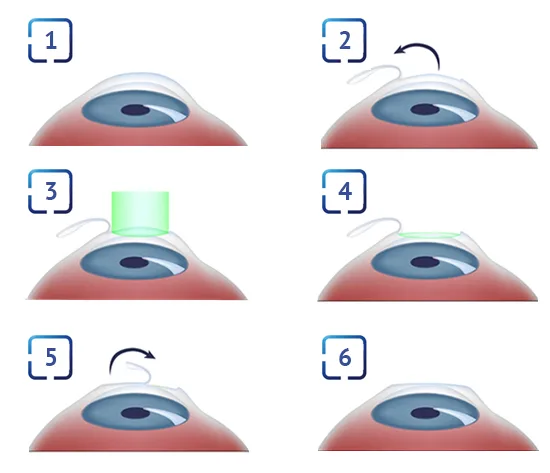
Our all-laser LASIK uses no metal blade. A customized corneal flap is created with the iFS Plus femtosecond laser, the flap is lifted, and the deeper corneal layer (stroma) is reshaped with an excimer laser before the flap is repositioned.

Six-step illustration of LASIK: flap creation, flap lift, excimer laser reshaping and flap repositioning

How it works

  1. 1. The deeper layers of the cornea are targeted with femto-LASIK.
  2. 2. The surgeon creates a flap with a femtosecond laser and lifts it.
  3. 3. The stroma is reshaped with an excimer laser.
  4. 4. This changes the curvature of the cornea.
  5. 5. The flap is repositioned.
  6. 6. After surgery, the cornea keeps its new shape.

Benefits

  • Corrects most levels of myopia, hyperopia and astigmatism
  • Short procedure — laser time is under a minute per eye
  • Laser-guided precision
  • Fast visual recovery; many patients notice clearer vision the same day

Laser-assisted sub-epithelial keratectomy

LASEK

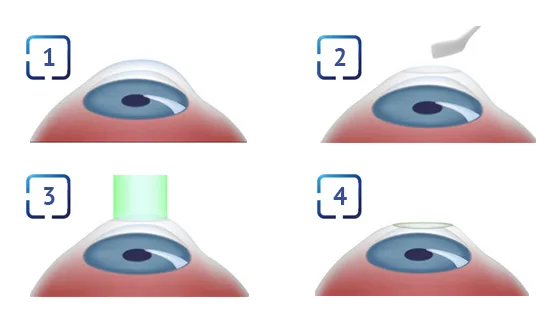
In LASEK the thin surface layer of the cornea (epithelium) is moved aside and the stroma beneath is reshaped with an excimer laser. Our LASEK uses the AMARIS 750S and is not an alcohol-based technique. The epithelium then regenerates over the treated surface.

Four-step illustration of LASEK: epithelium removal, excimer laser reshaping and epithelial recovery

How it works

  1. 1. LASEK is a surface form of laser eye surgery.
  2. 2. The epithelium is removed.
  3. 3. The cornea is reshaped with an excimer laser.
  4. 4. After treatment, the epithelium recovers.

Benefits

  • No stromal flap, so no flap-related complications
  • Preserves more corneal tissue — often suits thinner corneas
  • Lower risk of dry eye than LASIK
  • Lower incidence of corneal haze with modern techniques

LASIK vs. LASEK at a glance

Comparison of LASIK and LASEK
AspectLASIKLASEK
Treated layerFlap including corneal stromaSurface epithelium only
Procedure timeAbout 15 minutes per eyeAbout 15 minutes per eye
RecoveryFaster; most people drive and work within about 48 hoursSlower; around 4–7 days, with vision sharpening over several weeks
ComfortUsually little discomfortMore discomfort in the first 24–48 hours
Often suitsSufficient corneal thickness, quick recoveryThinner or flatter corneas, contact sports

Flapless · about 2 mm incision

Clear Smile LASIK

Unlike conventional LASIK, Clear Smile LASIK does not create a corneal flap. A low-energy laser forms a thin lens-shaped piece of tissue (lenticule) inside the corneal stroma, which is then removed through a small incision of about 2 mm near the edge of the cornea. Surgery is performed with the FEMTO LDV Z8, a laser system designed to reduce corneal damage through micro-incisions.

Three illustrations of Clear Smile LASIK: lenticule formation, lenticule extraction and corrected cornea
  1. 1. Lenticule formation
  2. 2. Lenticule extraction
  3. 3. Vision correction

Advantages

  • Low-energy laser, customized for each patient
  • Up to 10× faster laser repetition rate for minimal corneal damage
  • Fast visual recovery

With higher-energy conventional systems, gas bubbles can form in the tissue layer and cause more tissue damage. Clear Smile LASIK aims to leave a smooth corneal stroma.

May suit you if

  • You want a quick recovery
  • You are concerned about dry eye after surgery
  • You have high myopia or high astigmatism
  • You want to minimize corneal damage
  • You want to lower the risk of keratoconus

Who is a candidate?

Thorough screening is required for both procedures. Typical criteria include being roughly 18–40 years old with a stable prescription, myopia below −14.00 D, hyperopia below +6.00 D and astigmatism below 6.00 D, healthy corneal shape and thickness, normal pupil size, healthy tear production and no history of eye disease.

May not be suitable with

  • Thin or irregular cornea
  • Unstable prescription
  • Eye disease such as cataract, glaucoma or ocular hypertension
  • Diabetic retinopathy or autoimmune disorders
  • Pregnancy or breastfeeding
  • Severe dry eye or large pupils
  • Certain medications or prior eye surgery

Risks to know about

As with any surgery, risks exist. They can include dry eye, glare, halos or starbursts around lights, under- or over-correction that may need further treatment, flap complications (LASIK), corneal haze, infection and, rarely, corneal ectasia. Careful screening and following aftercare instructions help reduce these risks.

Aftercare tips

  • Follow all post-operative instructions and use prescribed eye drops
  • Don’t rub your eyes for 2 weeks
  • Avoid strenuous exercise for 1 week
  • Avoid pools, the sea, lakes and spas for at least 1 week
  • Replace old make-up and skip eye make-up for several days
Check My Eligibility

Implantable Lenses

Phakic IOL (ICL) for high myopia

Phakic intraocular lenses (IOLs) are clear lenses implanted either between the cornea and the iris or just behind the iris, without removing your natural lens. They work like a contact lens from inside the eye and are an alternative to laser surgery for moderate to severe nearsightedness. Patients with high myopia or very thin corneas, who may not be suitable for LASIK or LASEK, can often receive an implantable lens instead.

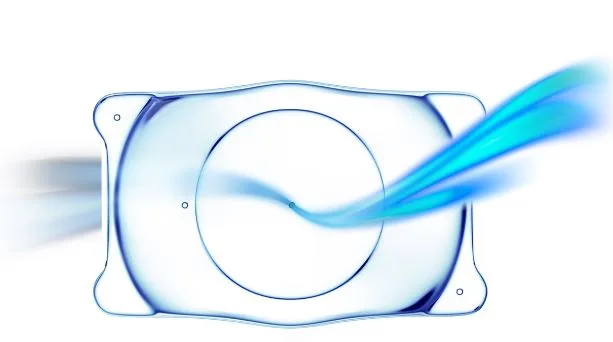
Illustration of a thin, flexible implantable lens used in phakic IOL surgery

Benefits

  • No corneal tissue is removed
  • Works particularly well for high myopia
  • Lower risk of dry eye and regression than laser surgery
  • Made of biocompatible material
  • The procedure takes about 15–30 minutes
  • The lens can be removed or replaced if needed

Lens options

Phakic IOL lens options with correction range and position
LensCorrection rangePosition
Visian ICLSTAAR SurgicalMyopia −3.0 to −23.5 DBehind the iris
Toric ICLSTAAR SurgicalMyopia −3.0 to −23.5 D; astigmatism −1.0 to −6.0 DBehind the iris
Aqua ICLSTAAR SurgicalMyopia −0.5 to −18.0 D; astigmatism 0.75 to 6.0 DBehind the iris
ArtiflexOphtecMyopia −2.0 to −14.5 DIn front of the iris
Toric ArtiflexOphtecMyopia −2.0 to −14.5 D; astigmatism −1.0 to −5.0 DIn front of the iris

Typical recovery for all lenses is 2–3 days. Night glare may occur with pupils larger than about 7 mm. Lens choice depends on your eye measurements.

The procedure

Phakic IOL surgery is an outpatient procedure. Your eye is numbed with drops, and the lens is inserted through a small incision that usually needs no stitches. Vision may be hazy and light-sensitive right after surgery, and scheduled check-ups follow. You may be asked to stop wearing contact lenses for some time before your examination so your prescription can be measured accurately.

Clear lens extraction

Clear lens extraction (refractive lens exchange) replaces the natural lens with an artificial IOL. It may be an option when a prescription is outside the range for laser surgery, or for very high near- or farsightedness.

Presbyopia

Seeing near and far again after 40

Presbyopia is a normal part of ageing that becomes more apparent in your 40s and 50s. The lens inside the eye gradually loses its elasticity and its ability to change focus, making small print harder to read. Because standard laser vision correction does not change the lens, it cannot correct presbyopia on its own.

Common symptoms

  • Blurry close vision that starts after age 40
  • Difficulty switching focus between near and distance
  • Eye strain and headaches during close work

Diagnosis

A comprehensive presbyopia examination checks lens elasticity, focusing ability, eye coordination and muscle control so that a treatment plan can be tailored to your eyes.

Multifocal laser vision correction

Laser Blended Vision (LBV) LASIK

Laser Blended Vision (LBV) combines the accuracy of corneal laser surgery with an increased depth of field. Based on your eye’s natural spherical aberrations, it extends conventional monovision with a customized ablation profile.

  1. 1Your dominant eye is corrected for distance vision.
  2. 2Your non-dominant eye is made slightly nearsighted (around 1.50 D) for near vision.
  3. 3A wavefront-optimized profile increases the depth of field of each eye.
  4. 4The brain fuses both images in a “Blend Zone” covering near, intermediate and far distances.

LBV is planned individually from your preoperative measurements and the functional age of your eyes. It may also reduce night-vision issues such as glare compared with conventional approaches; results vary.

Multifocal lens surgery

From the early 40s, lens-based presbyopia correction is also possible: the natural lens is replaced with a multifocal intraocular lens using the Catalys femtosecond laser, which can address presbyopia together with myopia, hyperopia and astigmatism.

Corneal inlay

The clinic’s original site also lists the Raindrop corneal inlay — a tiny, clear inlay placed in one cornea in a procedure of under 10 minutes. Please ask at your consultation whether this option is currently available.

Cataracts

Laser cataract surgery with Catalys

A cataract is a clouding of the eye’s lens. As we age, proteins in the lens break down and it becomes cloudy. Cataracts usually develop slowly and painlessly, so you may not notice one at first, but over the years they are likely to affect vision. Cataracts are very common with age — most people over 65 have some degree of cataract. A cataract is not caused by overusing your eyes and does not spread from one eye to the other.

Signs of a cataract

Blurring
Vision becomes misty, or glasses always seem dirty.
Glare
Bright light and car headlights feel more dazzling than usual, with halos.
Double vision
Double images for near or distant objects.
Faded colours
Colours look washed out.
Changing prescriptions
Frequent changes to your glasses prescription.

An ophthalmologist can diagnose a cataract during a dilated eye examination.

Causes

Age-related
The most common type (nuclear, cortical and posterior subcapsular).
Congenital
Present at birth or developing in the first year of life.
Traumatic
Caused by an injury to the eye.
Secondary
Linked to medications such as corticosteroids or to diseases such as diabetes.

Treatment

Cataract surgery removes the clouded lens and replaces it with a new artificial lens. With a multifocal lens, surgery can treat the cataract and also correct myopia, hyperopia and astigmatism at the same time.

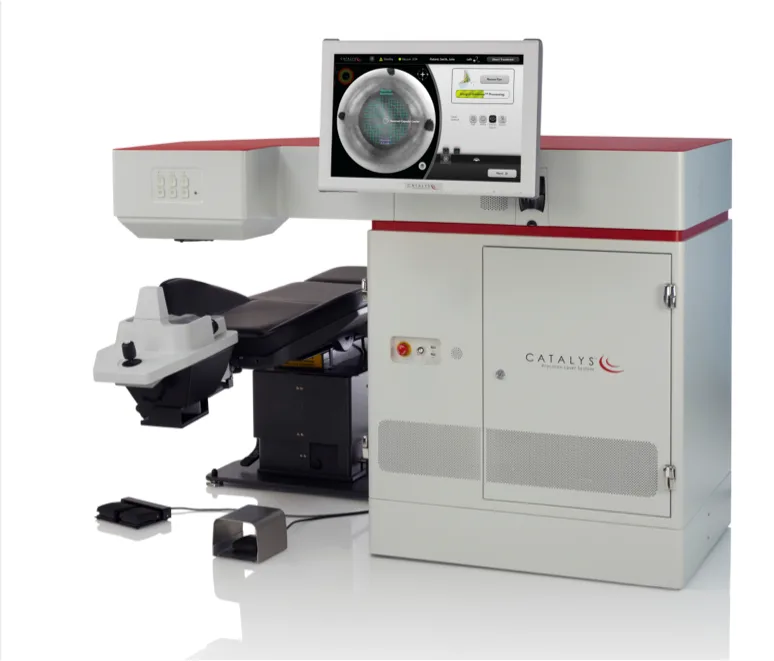
CATALYS Precision Laser System used for femtosecond laser-assisted cataract surgery

CATALYS Precision Laser System

The CATALYS Precision Laser System is designed specifically for laser cataract surgery. It performs the capsulotomy, lens fragmentation and corneal incisions — replacing some of the most technically demanding manual steps of conventional surgery with a reproducible laser technique.

Liquid Optics interface
Gentle docking with minimal rise in eye pressure and clear optics for imaging and laser delivery.
Integral Guidance system
3D full-volume optical coherence tomography (OCT) and automated surface mapping guide the laser.
Precise capsulotomy
Laser-created openings in the lens capsule, precise to within 30 µm.
Lens softening
Segmentation and softening of the cataract with adjustable grid sizes.
Corneal incisions
Single- and multi-plane arc incisions centred on anatomical landmarks.
Ask About Cataract Surgery

Your Visit

From eye exam to follow-up

It is important to understand your vision before deciding on any procedure. Our comprehensive exam comes first, and you are free to decide afterwards.

  1. 01

    Book & prepare

    Request a consultation online. If you wear contact lenses, you may need to stop wearing them for a period before your exam.

  2. 02

    Comprehensive eye exam

    About 30–40 minutes, including tests such as slit-lamp, fundus, corneal thickness, topography, pupil size and tear (Schirmer) tests.

  3. 03

    Consultation

    Your ophthalmologist explains which procedures suit you, along with risks and costs. There is no obligation to have a procedure.

  4. 04

    Surgery & follow-up

    Procedures are performed with dedicated laser systems, followed by scheduled post-operative check-ups.

Patient stories

Comments shared by patients on the clinic's website. Individual experiences and results vary.

  • “I was really scared about doing LASIK. However, the clinic staff was really professional and my LASIK surgery went well. I am happy to be glasses-free.”
    Janson T. · iFS all-laser LASIK · Student
  • “I was very pleased with my experience and especially the results. I did not encounter anyone who was anything but courteous and professional.”
    Cynthia M. · LASIK · Teacher
  • “The surgery was even easier than I ever expected. I would do it again in a second, and would recommend it to anyone.”
    Edward S. · LBV · Teacher · Canada
  • “I am 51 years old and now have eyes as I had as a child!”
    Sholpan K. · Multifocal IOL cataract surgery · Kazakhstan

FAQ

Frequently asked questions

Planning vision correction or cataract surgery in Seoul? Here are answers to the questions patients ask us most often, including VAT and payment.

Am I a good candidate for vision correction surgery?

We can treat most people over 19 years old whose prescription has been stable for 12 months. A comprehensive examination and consultation determine your suitability based on your prescription, corneal measurements, eye health and lifestyle.

Do I need to stop wearing contact lenses before my exam or surgery?

Yes. Depending on the type of lenses you wear, you will need to leave them out and wear glasses for a period before your consultation and treatment. Contact lenses can change the shape of the cornea and lead to inaccurate measurements.

How long does the eye examination take?

The comprehensive examination takes about 30–40 minutes, and you are under no obligation to have a procedure afterwards.

Will I experience discomfort during or after treatment?

Anaesthetic eye drops numb your eye so you stay comfortable during the procedure. After LASIK, you may feel some grittiness, light sensitivity and watering for a short while. After surface treatments such as LASEK, mild discomfort is common in the first 24–48 hours.

When can I drive and return to work?

LASIK has a faster visual recovery, and most people can drive and return to work within about 48 hours unless their work environment is very dusty. Recovery after LASEK usually takes about 4–7 days.

How much will my vision improve? Will I need glasses again?

The outcome depends on your original prescription. We cannot guarantee 20/20 vision, but we can estimate likely results after your examination. Most patients no longer depend on glasses for distance; some may still need them for specific tasks, and reading glasses may become necessary with age because of presbyopia.

Is the procedure safe?

All laser and lens procedures are surgery and carry some risk, such as dry eye, glare or halos, under- or over-correction and, rarely, infection. Careful screening, experienced surgeons and following aftercare instructions help keep risks low. Your doctor will explain the specific risks for you.

What is the difference between LASIK, LASEK and Clear Smile LASIK?

LASIK reshapes the cornea under a thin flap for fast recovery. LASEK treats only the surface layer, preserving more corneal tissue, with a slightly longer recovery. Clear Smile LASIK removes a small piece of tissue through an incision of about 2 mm without creating a flap. Which suits you depends on your corneal measurements.

What if my cornea is too thin or my prescription is very high?

Implantable lenses (phakic IOLs such as the Visian ICL or Artiflex) may be an alternative. They correct vision from inside the eye without removing corneal tissue and can be removed or replaced if needed.

What are my options for presbyopia or cataracts?

For presbyopia, options include Laser Blended Vision (LBV) LASIK and multifocal lens surgery. For cataracts, we offer laser-assisted cataract surgery with the Catalys femtosecond laser, including multifocal lenses that can also correct near- and farsightedness and astigmatism.

Is VAT included in treatment prices?

Cosmetic-purpose procedures such as laser vision correction (LASIK, LASEK and Clear Smile LASIK) may be subject to 10% VAT in Korea, charged separately from the quoted price. Medically necessary treatments such as cataract surgery are generally exempt from VAT. The final amount is confirmed at your consultation.

Can I get a tax refund on vision correction surgery as a foreign visitor?

No. The tax refund program for medical treatment received by foreign visitors has ended, so VAT paid on cosmetic-purpose procedures such as laser vision correction cannot be refunded.

What payment methods do you accept?

We accept credit cards and cash.

Do you offer English-speaking support?

Yes. English service and concierge support are available for international patients before, during and after treatment.

How do I book a consultation?

You can request a consultation and book online in English through Medical Travel Korea. Share your prescription, any previous eye surgery and your travel dates so we can plan your visit.

Visit & Contact

Find us by Gangnam Station Exit 8

Our staff and surgeons are happy to answer your questions. Tell us about your eyes and when you will be in Seoul, and we will help you get the information you need to make the best choice.

Book a consultation

Request a consultation and book your visit online in English through Medical Travel Korea.

Opening hours

Mon – Thu
9:30 AM – 6:00 PM
Friday
9:30 AM – 8:00 PM (late hours)
Saturday
9:30 AM – 4:00 PM
Sun & holidays
Closed
  • · Lunch break: 1:00 PM – 2:00 PM
  • · Closed on Sundays and Korean public holidays
  • · Hours may change — please confirm when booking

Location

Glory Seoul Eye Clinic
3 Seocho-daero 74-gil, Seocho-gu, Seoul 06620, Republic of Korea
Seocho-dong, right by Gangnam Station Exit 8

Getting here

Subway
Gangnam Station (Line 2 and Shinbundang Line), Exit 8. The clinic is on Seocho-daero 74-gil, just off the exit on the Seocho-dong side.
Address
3 Seocho-daero 74-gil, Seocho-gu, Seoul (lot address: 1320 Seocho-dong).